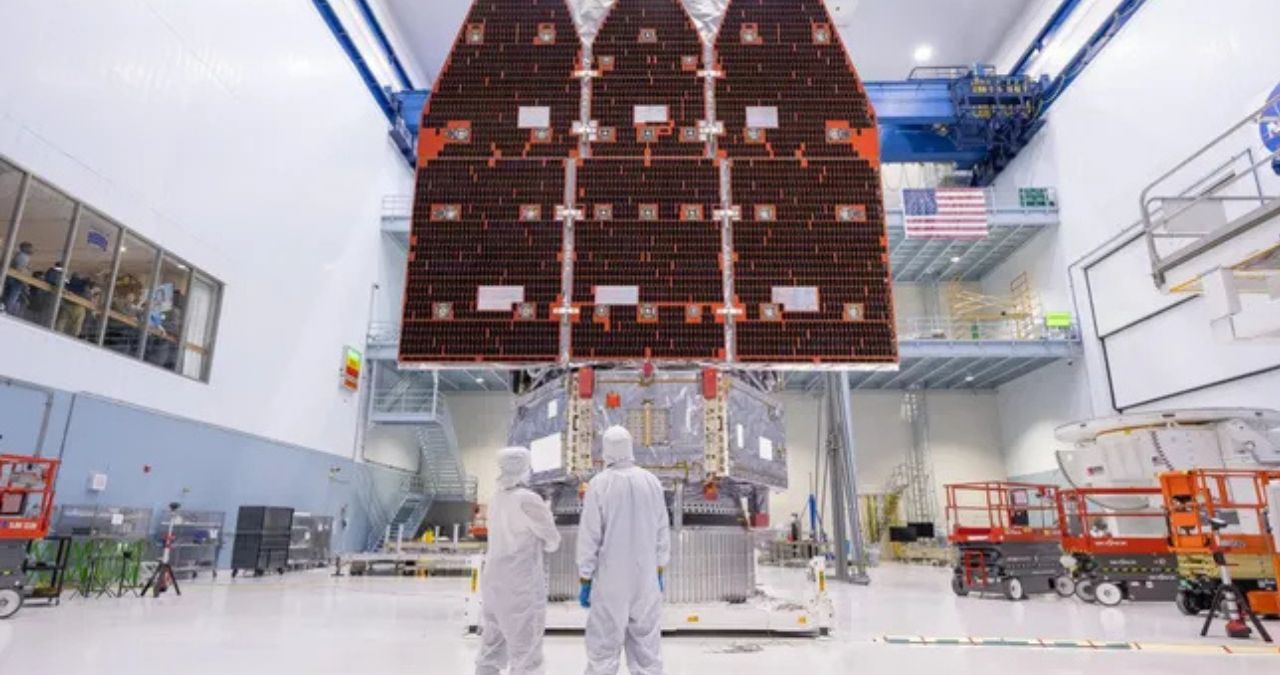

NASA has confirmed the completion of its Nancy Grace Roman Space Telescope, a next generation observatory designed to study dark energy, exoplanets, and infrared astrophysics. The agency has now set an early September launch window for the mission, which is expected to lift off from Cape Canaveral, Florida.
The telescope, named after NASA’s first chief astronomer, is built to survey vast areas of the sky at infrared wavelengths. Its primary mirror is 2.4 meters in diameter, the same size as the Hubble Space Telescope, but Roman is engineered to capture images with a field of view 100 times larger than Hubble’s. This wide field capability will allow scientists to map the structure of the universe and investigate the nature of dark energy and dark matter.
Mission Objectives and Scientific Goals
The Roman Space Telescope is designed to address fundamental questions in cosmology and planetary science. Its main goals include measuring the expansion history of the universe to understand dark energy, completing a census of exoplanets using microlensing techniques, and surveying the Milky Way for planetary systems.
Roman will also perform near infrared observations to study galaxy formation and evolution. The mission is expected to collect data on billions of galaxies over its five year primary mission lifespan.
Launch Timeline and Readiness
NASA has completed final integration and testing of the space telescope. The observatory is now in its launch preparation phase. According to the agency, the telescope is scheduled to launch no earlier than early September 2026 aboard a SpaceX Falcon Heavy rocket from Launch Complex 39A at Kennedy Space Center.
The launch window extends across several weeks to allow for optimal orbital insertion. Mission planners have scheduled the observatory for a trajectory to the Sun Earth L2 Lagrange point, a region of gravitational stability located about 1.5 million kilometers from Earth.
Technical Specifications
The Nancy Grace Roman Space Telescope features a primary mirror with a diameter of 2.4 meters. It carries two main instruments: the Wide Field Instrument and the Coronagraph Instrument. The Wide Field Instrument will provide high resolution imaging and spectroscopy over a large area of the sky. The Coronagraph Instrument is designed to directly image exoplanets by blocking the light from their host stars.
The telescope also includes a 288 megapixel infrared detector array, one of the largest ever flown for space astronomy. This array will allow the observatory to produce deep, wide field images of the universe.
Comparison with Other Space Observatories
While the James Webb Space Telescope focuses on deep, narrow field observations of the early universe, Roman is designed for wide area survey work. Scientists describe the two telescopes as complementary: Roman will identify targets for Webb to examine in greater detail. Hubble, meanwhile, continues to operate in both visible and ultraviolet light, whereas Roman works primarily in infrared.
The Roman telescope’s survey speed is expected to accelerate discoveries in transient astronomy, including supernovae and gamma ray bursts.
Implications for Future Space Research
The successful completion of the Nancy Grace Roman Space Telescope marks a milestone in NASA’s astrophysics program. The mission is expected to produce a data set that will be publicly available to researchers worldwide, following the agency’s open data policies.
Astronomers anticipate that Roman will contribute to the study of dark energy, the mysterious force driving the accelerated expansion of the universe, and may help determine whether the standard cosmological model requires revision.
The telescope is slated to operate for at least five years, with a design life that may extend beyond that period. Science operations are expected to begin approximately six months after launch, following a period of instrument calibration and commissioning.
Source: GeekWire