
Google has introduced a new security feature for Android devices designed to help forensic investigators analyze sophisticated spyware attacks. The feature, called Intrusion Logging, is an opt-in tool that stores detailed system logs for later examination.
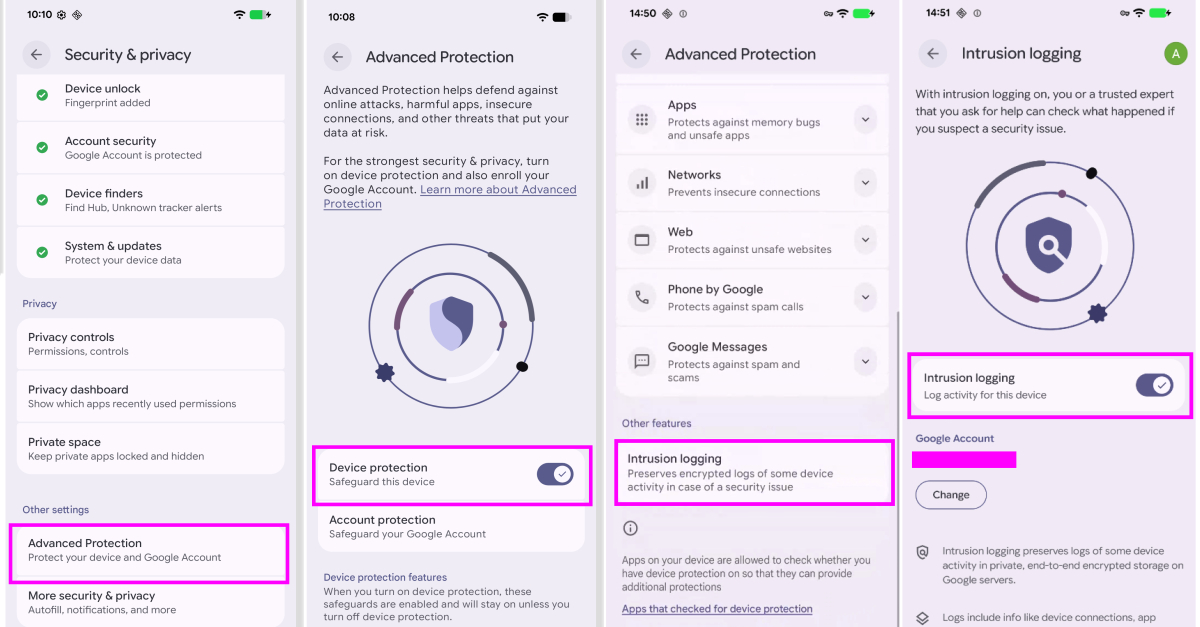
The company announced the feature on Tuesday, stating it is available as part of the Advanced Protection Mode. Intrusion Logging enables “persistent and privacy-preserving forensics logging to allow for investigation of devices in the event of a suspected compromise,” Google said in a statement. The tool is intended for users who may be targets of highly advanced digital threats, such as journalists, activists, or government officials.
Intrusion Logging works by recording system events that could indicate malicious activity. These logs are stored securely on the device and are not automatically uploaded to Google’s servers. Access to the logs requires the device owner’s explicit consent, meaning the data remains under the user’s control until they choose to share it with a forensic examiner.
How Intrusion Logging differs from existing security tools
Unlike standard Android security features that focus on real-time threat detection, Intrusion Logging is designed for post-incident analysis. It captures granular data about process executions, file modifications, and network connections that could help identify the source and method of a spyware infection.
This forensic approach addresses a gap in mobile security. While many platforms can block known threats, sophisticated spyware often uses zero-day exploits or advanced obfuscation techniques that evade real-time detection. By preserving detailed logs, investigators can reconstruct attack chains even after the malware has been removed.
Privacy and user control emphasized
Google has stressed that the feature is privacy-preserving by design. The logs are encrypted and stored locally, and the user must actively enable the feature. Google will not have access to the log data unless the user explicitly chooses to share it during a forensic investigation.
This approach contrasts with some enterprise security solutions that automatically collect telemetry data. Android’s Intrusion Logging is aimed at individual users who face elevated risks, rather than commercial deployments.
Targeted at high-risk users
The feature is part of Android’s broader Advanced Protection Program, which already includes stricter app installation policies, enhanced phishing protections, and mandatory security keys for account access. Intrusion Logging adds a new layer for users who believe their device may have been compromised by state-sponsored or commercially available spyware.
High-profile cases of spyware, such as Pegasus from the NSO Group, have highlighted the need for better mobile forensic capabilities. These tools often exploit vulnerabilities in messaging apps or operating systems to gain deep access to a device, making them difficult to detect without specialized logging.
Expected impact and rollout plans
Google has not provided a specific release date for the feature but indicated it will roll out gradually to devices running Android 14 and later. The company is expected to provide further technical documentation for forensic analysts and security researchers in the coming months.
The move aligns with broader industry efforts to improve transparency and accountability in mobile security. Other platforms, including Apple, have also introduced similar forensic logging features for iPhones and iPads, underscoring a growing recognition that real-time defenses alone are insufficient against the most advanced threats.
Source: GeekWire