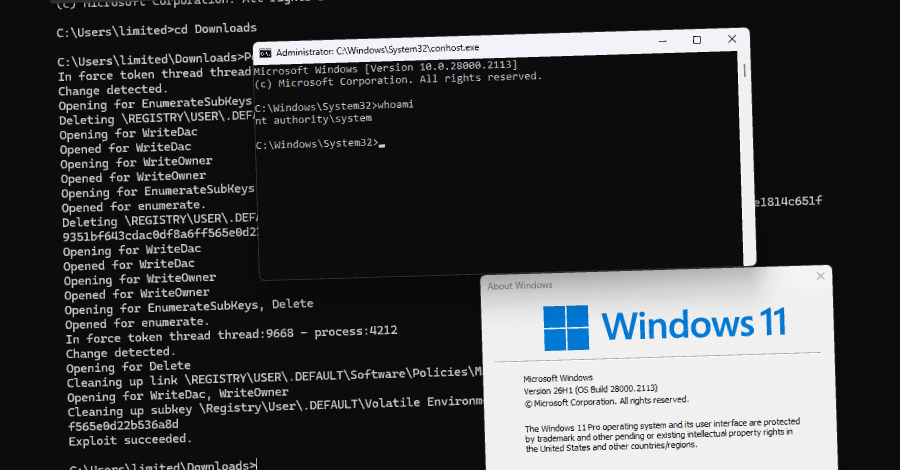

A recently disclosed zero-day privilege escalation vulnerability, codenamed MiniPlasma, affects fully updated Windows systems and allows attackers to gain SYSTEM level access. Security researcher Chaotic Eclipse, who previously uncovered the Windows flaws YellowKey and GreenPlasma, released a proof-of-concept (PoC) exploit for the flaw.
The vulnerability resides in the Windows Cloud Files Mini Filter Driver, known as “cldflt.sys.” This driver manages synchronization and access for cloud-based files within the Windows operating system. A flaw in how the driver handles specific requests permits an attacker to elevate their privileges from a standard user account to the highest level, known as SYSTEM. This level of access effectively grants complete control over the affected machine.
Chaotic Eclipse, a well-known figure in vulnerability research, documented the exploit and made the PoC code publicly available. This action follows their previous disclosures related to the Windows ecosystem, including the YellowKey and GreenPlasma vulnerabilities. The release of functional exploit code increases the immediate risk for users and organizations, as it lowers the barrier for potential attacks.
Vulnerability Details and Impact
The MiniPlasma zero-day targets systems running the most recent versions of Windows, which include all current security patches. This characteristic makes the flaw particularly concerning, as it bypasses existing protections provided by standard update cycles. An attacker must already have a foothold on the target system, typically through a standard user account, to trigger the escalation.
Once exploited, the vulnerability allows the attacker to run arbitrary code with SYSTEM privileges. This capability can be used to disable security software, install persistent malware, steal sensitive data, or move laterally across a network. The Microsoft Cloud Files Mini Filter Driver is a core component of Windows, meaning the flaw has a wide potential impact across enterprise and consumer environments.
Implications and Responses
The public availability of a working exploit shifts the situation from a theoretical risk to a tangible threat. While Microsoft has not yet issued a formal advisory or patch for MiniPlasma, the company typically investigates reported vulnerabilities and may release a fix through its monthly Patch Tuesday updates or an out-of-band security bulletin.
Security experts advise organizations to monitor for unusual system behavior and restrict user permissions where possible. Endpoint detection and response systems should be configured to flag attempts to interact with the cldflt.sys driver in suspicious ways. Until an official patch is available, administrators may consider disabling the Cloud Files Mini Filter Driver in environments where its functionality is not critical, though this could impact cloud file synchronization services.
The vulnerability underscores the ongoing challenge of securing core operating system components. Even fully patched systems can be vulnerable to exploits that target driver-level code, which runs with high integrity and is often complex to audit.
Chaotic Eclipse has stated the PoC was released to demonstrate the need for more rigorous security reviews of Windows kernel components. Microsoft has not publicly commented on MiniPlasma at the time of writing. The cybersecurity community is actively analyzing the exploit code to develop detection signatures and mitigation strategies.
Users and administrators are advised to apply any future patches from Microsoft immediately upon release and to review their security posture for defense-in-depth measures that can limit the damage from privileged account compromise.
Source: Chaotic Eclipse Security Research