
London, United Kingdom. The digital distribution platform VaultN has entered into a partnership with Take-Two Interactive, the company announced last year. This agreement adds the major game publisher to a client list that already includes Bethesda, Team17, Landfall, and Curve.
The partnership represents a significant step in VaultN’s stated goal of creating a more unified ecosystem for digital game distribution. The company argues that the current market landscape suffers from fragmentation, where publishers and developers face challenges in managing product visibility across multiple storefronts and regions.
Structural approach to visibility
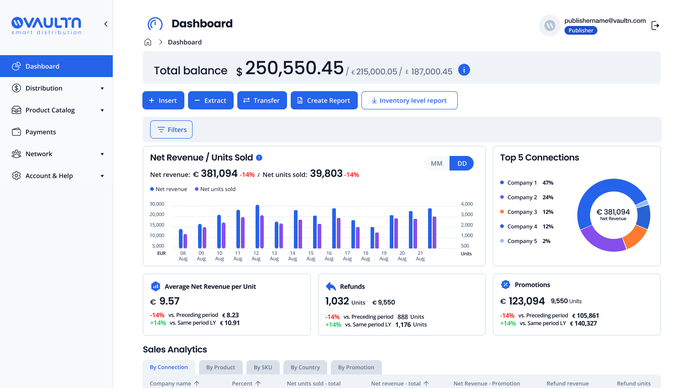
VaultN positions its platform as a solution to this fragmentation. The company provides a centralised dashboard that allows publishers to manage catalogue listings, pricing, and promotional schedules across numerous digital retailers from a single interface.
According to company representatives, the core issue facing the industry is not a lack of distribution channels but a lack of cohesion between them. Publishers must often submit product data manually to each platform, leading to inconsistencies in product descriptions, pricing errors, and missed promotional opportunities.
The platform aims to address these inefficiencies by acting as a middleware layer that standardises data submission across all major digital stores. This includes automated updates for pricing changes, regional restrictions, and asset delivery.
Client portfolio growth
Take-Two Interactive, the parent company of Rockstar Games and 2K Games, joins a roster that spans both AAA and independent publishers. Bethesda, a subsidiary of Microsoft, uses the platform to manage its catalogue. Team17, known for titles such as the Worms series, and Landfall, the studio behind Totally Accurate Battle Simulator, are also clients.
Curve Games, another publisher on the VaultN network, further demonstrates the platform’s reach across different segments of the gaming industry. The diversity of these clients suggests that the demand for centralised distribution tools extends across the entire publisher spectrum.
Industry context
The game distribution market has grown increasingly complex in recent years. Digital storefronts such as Steam, Epic Games Store, GOG, and various console-specific marketplaces each have their own technical requirements and business rules.
For smaller teams especially, managing this complexity can consume resources that would otherwise go toward development. VaultN’s pitch is that a unified approach reduces administrative overhead and allows publishers to maintain consistent product visibility across all channels.
The company also notes that structural inconsistencies can negatively impact discoverability. A game that appears correctly on one storefront might have missing metadata or incorrect pricing on another, reducing its chances of being found by potential buyers.
By standardising the submission process, VaultN aims to ensure that product information remains uniform and accurate, regardless of where a customer shops.
Implications for the digital ecosystem
The addition of a major publisher like Take-Two gives VaultN increased credibility as a distribution partner. It also signals that large publishers see value in consolidating their digital distribution workflows.
Analysts within the games industry have noted that as storefronts proliferate, the need for middleware solutions will likely grow. The success of platforms like VaultN may depend on their ability to integrate with new storefronts as they emerge and to adapt to changing technical standards across existing ones.
The partnership also highlights a broader shift in the games market. Digital sales now account for the vast majority of game revenue, and publishers are investing in infrastructure that supports that reality.
Looking ahead
VaultN has not announced specific financial terms of the Take-Two agreement or disclosed any future partnership plans. However, the company is expected to continue expanding its client base and platform capabilities.
Industry observers will watch for further integrations with additional storefronts and potential features such as automated localisation, regional pricing intelligence, and real-time sales analytics. These features would represent a natural evolution of the platform’s current capabilities.
The company has indicated that its long-term goal remains the establishment of a fully unified digital distribution ecosystem where publishers can manage their entire global catalogue from a single point of control.
Source: GamesIndustry.biz