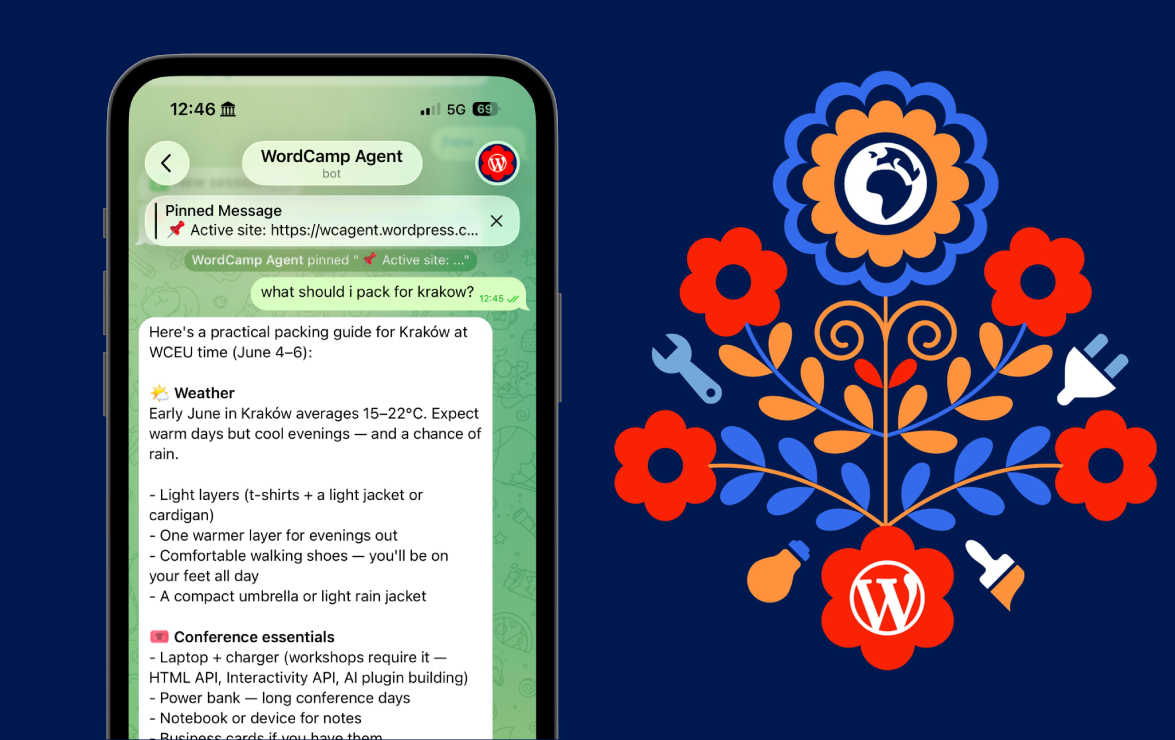

A new Telegram Bot called WordCamp Agent is offering conference attendees a practical demonstration of a proposed WordPress Core feature that could fundamentally change how the Content Management system interacts with artificial intelligence agents.
The bot, built by Automattic and WordPress contributors, is designed for attendees of WordCamp Europe 2026 in Kraków. It allows users to plan travel, browse the conference schedule, save session preferences, and store notes. The service is free and requires only a WordPress.com account to use.
Behind the bot lies a system called WordPress Guidelines. This framework provides a standardized way for WordPress sites to store four types of information that AI agents can read and write: instructions, skills, memory, and artifacts. According to the project team, these are all represented as a single custom post type called `wp_guideline`, classified by a dedicated taxonomy, and accessible via standard REST API endpoints.
The significance of the project extends beyond a simple conference assistant. Guidelines is already shipping in Gutenberg 23.2.2, the standalone plugin that serves as the testing ground for the WordPress block editor and related core features. The system is currently powering several other projects, including WordPress Agent, WordPress Workspace, Desktop Mode, Lately, and PushMD. The next step, according to the developers, is to propose the feature for inclusion in WordPress Core itself.
How the Agent Works
When a user messages WordCamp Agent on Telegram for the first time, they are added as a contributor on a dedicated WordPress site at wcagent.wordpress.com. Their conversation, preferences, and notes are stored as standard WordPress content. This content is private to the user account and can be deleted at any time. The agent can provide travel tips, look up the live conference schedule, remember user interests and networking goals, and save notes from talks that can later be turned into posts.
The developers emphasize that no custom application code was written to create these behaviors. Every aspect of the agent, from its personality to its ability to look up schedules and remember user preferences, is defined by published Guidelines on the WordPress site. The implication is that anyone who can publish a post on a WordPress site can potentially extend the agent.
Technical Architecture
For developers, the Guidelines system relies on familiar WordPress primitives. It uses a single custom post type, a custom taxonomy to distinguish between the four types of agent-facing knowledge, native post revisions for versioning, and capability-based access control. Administrators can see all Guidelines, while contributors, authors, and editors can read and edit their own private guidelines. Subscribers are blocked at the post-type level.
Grzegorz Ziółkowski, a core contributor, has published a deeper technical walkthrough of the system.
Proposal for Core Integration
The team behind Guidelines argues that it should become a Core API because the alternative, where every plugin ships its own memory store, permissions model, and REST surface, represents the kind of fragmentation the WordPress project has historically avoided. They state that putting Guidelines in Core would make every WordPress site, regardless of where it is hosted, agent-ready by default.
The project is currently in a preview phase. The most practical way for developers and users to understand the system is to interact with WordCamp Agent and observe how it retains and uses information across sessions.
Source: WordPress Blog (en-blog.wordpress.com)