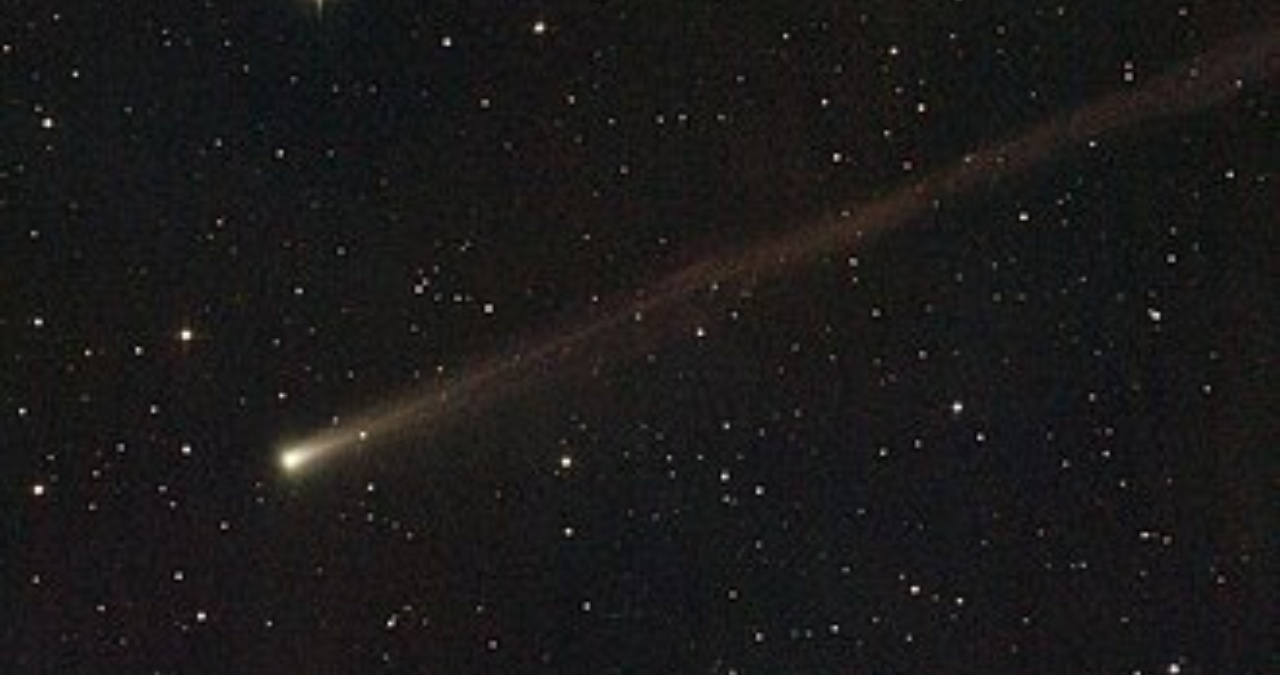

The Hubble Space Telescope has unexpectedly captured a rare cosmic event: a comet disintegrating in real time. The observation provides astronomers with a unique view of the internal structure and composition of these icy bodies as they break apart.
Comet C/2025 K1, which was first detected earlier this year, has been the subject of intense observation. The Hubble Space Telescope, operated by NASA and the European Space Agency, was not initially scheduled to observe this specific comet. A fortunate alignment of observation windows and the comet’s sudden increase in brightness allowed for the capture of the fragmentation process.
Observation Details and Discovery
The disintegration was first noted by ground-based observatories that reported a sudden surge in brightness, a common precursor to a comet’s breakup. Following this alert, mission controllers re-tasked Hubble to take a closer look. The resulting images show a clearly fragmented nucleus, with multiple pieces trailing behind the main body.
Scientists state that observing a comet from “the inside” is a rare opportunity. When a comet breaks apart, it exposes fresh, pristine material that has been frozen since the formation of the solar system. This material is typically hidden beneath a dark, crusty surface.
Scientific Significance
The data collected by Hubble allows researchers to analyze the composition of the comet’s interior. By studying the spectra of the released dust and gas, scientists can determine the chemical building blocks present. This information is critical for understanding the conditions present in the early solar system over 4.5 billion years ago.
The event is categorized as a “rare cosmic event” because most comets survive their journey around the sun. Fragmentation occurs when the comet’s icy nucleus, a mixture of dust, rock, and frozen gases, cannot withstand the thermal stress and gravitational forces experienced during its orbit.
The comet, officially designated C/2025 K1, was traveling at a high velocity as it approached the inner solar system. The increased solar radiation heated the nucleus, causing internal pressures to build until the structure could no longer hold together. Hubble’s high resolution imagery shows the resulting fragments separating at a slow but measurable rate.
Implications for Planetary Science
This observation provides a natural experiment for planetary scientists. Instead of sending a probe to a comet, which is expensive and time consuming, Hubble has captured a similar result remotely. The data will be used to refine models of comet structure and behavior, potentially improving predictions for future cometary activity.
The event also raises questions about the long term stability of other comets in the region. Fragments from C/2025 K1 are expected to continue on their orbital path, potentially creating a minor meteor shower in the future if they intersect Earth’s orbit. However, current trajectories indicate that the fragments pose no threat to Earth and will continue on a path away from our planet.
Astronomers will continue to monitor the remaining fragments with both Hubble and ground based telescopes over the coming weeks. The goal is to track the evolution of the fragments, observe how they further disintegrate, and analyze the dust cloud left behind.
Future Observations
The Hubble Space Telescope’s schedule is being adjusted to allow for follow up observations of the comet’s debris field. These follow up studies are expected to last for the next several weeks. The findings will be published in peer reviewed scientific journals, contributing to the broader field of cometary science and solar system formation.
The unexpected nature of this event highlights the value of having space based observatories like Hubble available for rapid response observations. The telescope’s unique capabilities in capturing high resolution ultraviolet and visible light images are essential for studying such dynamic and short lived events.
This event marks a significant step in understanding the lifecycle of comets. The direct observation of a nucleus fracturing provides empirical data that has been largely theoretical until now. Comet C/2025 K1 is expected to be fully dispersed within the next few months, leaving behind only a trail of debris to mark its passage through the inner solar system.
Source: Mashable