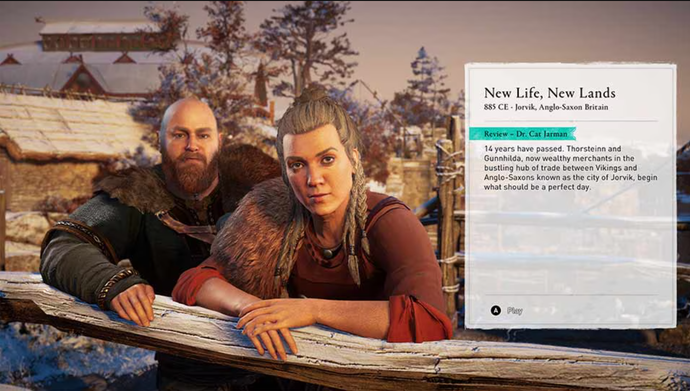

French video game publisher Ubisoft has been systematically converting assets from its game libraries into educational content for museums and television broadcasts. The initiative represents a significant expansion of how commercial video game technology is being applied outside the entertainment industry.
The company confirmed it has been producing historical and cultural educational material derived from its game franchises, including the Assassin’s Creed series. These assets, which include detailed 3D models of historical structures and environments originally built for gameplay, are now being licensed to cultural institutions and broadcasters.
Heritage preservation through game engines
Ubisoft’s work in this area builds on existing partnerships with institutions such as the Smithsonian American Art Museum and the British Museum. The company has previously contributed 3D reconstructions of historical sites to academic and cultural projects.
These reconstructions are built using the same game engines and design tools that power Ubisoft’s commercial titles. The company has stated that the level of detail required for historical accuracy in its games provides a valuable resource for educational purposes.
Content pipeline for nonentertainment sectors
The company has established a dedicated team to manage the conversion of game assets into educational content. This team works with historians and museum curators to ensure accuracy and relevance before the material is released for public use.
This process allows cultural institutions to access highquality digital reconstructions without bearing the development cost. Ubisoft has also produced documentarystyle segments for television that use inengine footage to illustrate historical events and settings.
One executive stated that the company’s games have “done something useful for the world” by providing a foundation for educational materials that would otherwise be prohibitively expensive to produce from scratch.
Commercial implications and industry precedent
Ubisoft is not the first game company to explore this crossover. Similar initiatives have been undertaken by The Creative Assembly, which has licensed assets from its Total War series for historical documentaries, and by Microsoft, which has used Minecraft for educational projects.
However, Ubisoft’s scale and the breadth of its historical game catalog make its approach notable. The company holds extensive digital models of Renaissance Italy, ancient Egypt, Vikingage Norway, and other historical periods, all of which can be adapted for educational use.
The initiative also provides a secondary revenue stream for assets originally created for game development. This financial aspect has been described as a way to offset the high costs of historical research and 3D modeling that Ubisoft undertakes for its flagship titles.
Reception and future deployment
Educators and museum professionals have responded positively to the availability of these assets. The digital reconstructions allow institutions to display accurate visualizations of historical sites that no longer exist or are inaccessible to the public.
Ubisoft has not disclosed the full list of current partnerships or the specific television programs that have used its content. The company has indicated that it expects to expand the program as more cultural institutions seek digital resources for exhibits and online education.
The publisher is also exploring the use of its game environments for virtual museum tours and interactive learning modules. These projects would allow users to explore historically accurate digital spaces without requiring a full game purchase.
Ubisoft stated that it intends to continue developing this division and expects to announce additional partnerships in the coming months. The company is also researching ways to allow educational institutions to customize the assets for specific teaching needs.
Source: GamesIndustry.biz