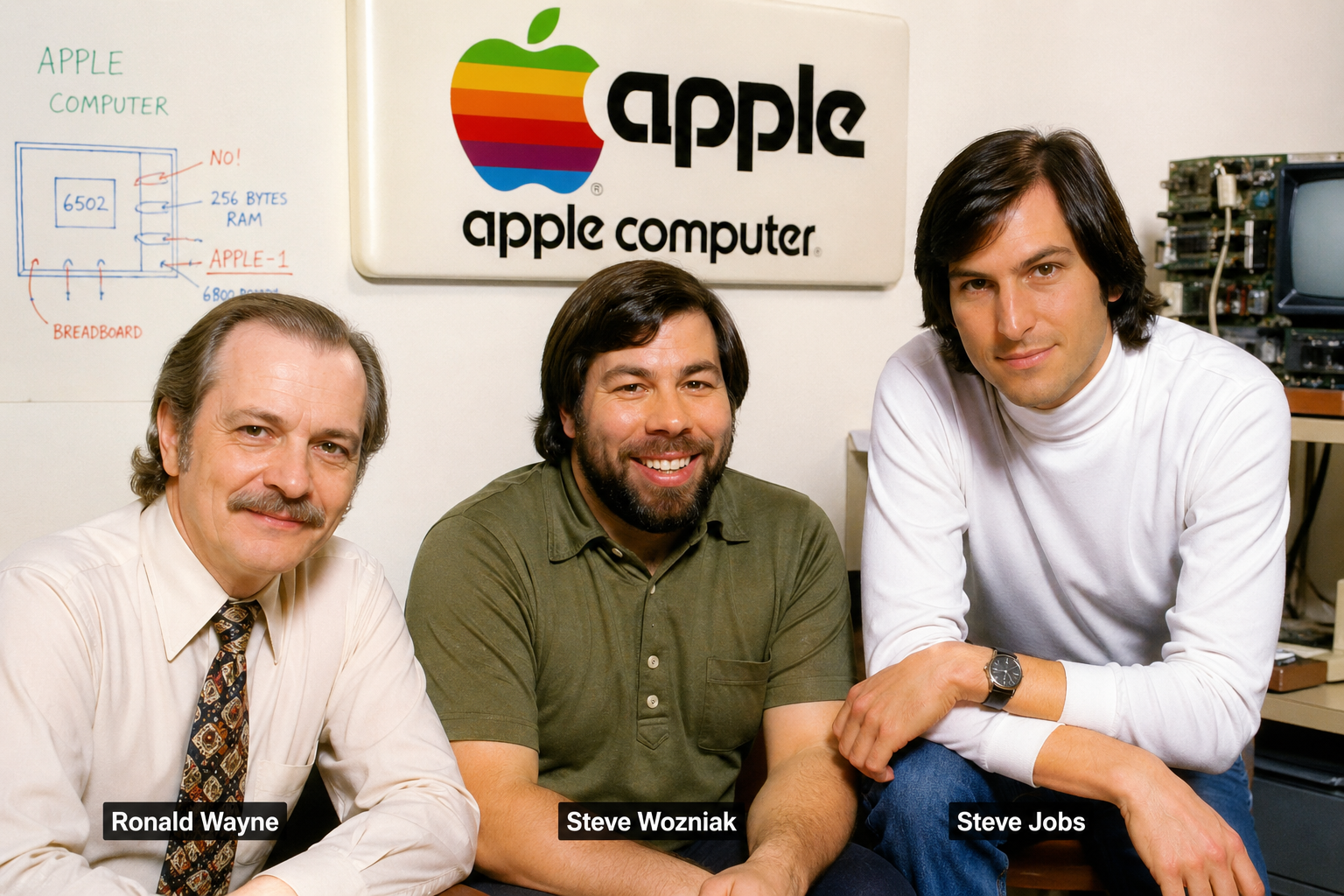

Ronald Wayne, a name often omitted from the history of Apple Inc., played a brief but pivotal role in the company’s founding. Wayne sold his 10 percent stake in the fledgling enterprise for just $800 in 1976, a decision that, had he held onto the shares, would be worth approximately $400 billion today.
Wayne co-founded Apple Computer on April 1, 1976, alongside Steve Jobs and Steve Wozniak. As the third partner, he was responsible for drafting the original partnership agreement and designing the company’s first logo. He also wrote the manual for the Apple I computer, providing foundational documentation for the product that launched the personal computing revolution.
The $800 exit and its historical context
Just 12 days after the partnership was formed, Wayne decided to sell his stake. He approached Jobs and Wozniak and relinquished his 10 percent ownership for $800. This decision was driven by personal financial risk; Wayne feared the debts of the new company could bankrupt him personally, as he was the only partner with significant assets at the time.
Wayne later explained that he did not want to chase a potentially high-risk venture and preferred a more stable financial path. His decision, while rational for his personal circumstances, resulted in the loss of what would become the world’s most valuable technology company stake. Adjusted for stock splits and growth, the 10 percent stake would now be valued at roughly $400 billion.
To put this figure into perspective, $400 billion exceeds the entire market capitalization of many major corporations today. It surpasses the value of companies like Tesla, Meta, and Berkshire Hathaway, making Wayne’s decision one of the most costly financial mistakes in entrepreneurial history.
Wayne’s later life and career
After leaving Apple, Wayne continued working in engineering and technical roles. He never returned to the technology startup scene and lived a modest life. In 2012, he sold a collection of Apple memorabilia, including the original partnership agreement, for hundreds of thousands of dollars, but he never sought wealth from the company’s success.
Wayne has publicly stated multiple times that he holds no regret for his decision. He has described the experience as a matter of personal risk tolerance and has maintained that he would not change his actions. He currently resides in a small town in Nevada and continues to speak occasionally about his brief time with Apple.
Implications for startup founders and investors
Wayne’s story serves as a cautionary tale about the high stakes and unpredictable outcomes of early-stage startup investing. It highlights the tension between personal financial security and the immense potential rewards of technological innovation. For founders and early employees, the decision to hold or sell equity can define their financial futures in ways that are difficult to predict.
Industry analysts point out that Wayne’s departure was not irrational given the context of 1976. The personal computer market was unproven, and Jobs and Wozniak were operating out of a garage with no guaranteed revenue. The decision to sell was a calculated risk management choice, not a failure of foresight.
The story also underscores the role of luck and timing in the technology sector. Many other early Apple employees and investors who cashed out early missed out on similar windfalls, though none as dramatically as Wayne.
Ongoing public interest and legacy
Interest in Ronald Wayne’s story persists decades later, largely due to the staggering scale of the lost fortune. Media outlets revisit the narrative periodically, especially during Apple product launches or when the company’s market valuation hits new records. Wayne’s experience has been referenced in business school case studies and motivational talks, often as an example of opportunity cost.
Historians note that Wayne’s contributions to Apple, though brief, were significant. His legal guidance helped establish the company’s initial structure, and his technical documentation supported early product development. The original partnership agreement he drafted remains a valuable historical artifact.
Looking ahead, Wayne’s legacy will likely continue to be discussed as a unique footnote in the history of Silicon Valley. No further developments are expected regarding his personal financial situation, and he has confirmed he has no interest in re-entering the technology business.
Source: GeekWire