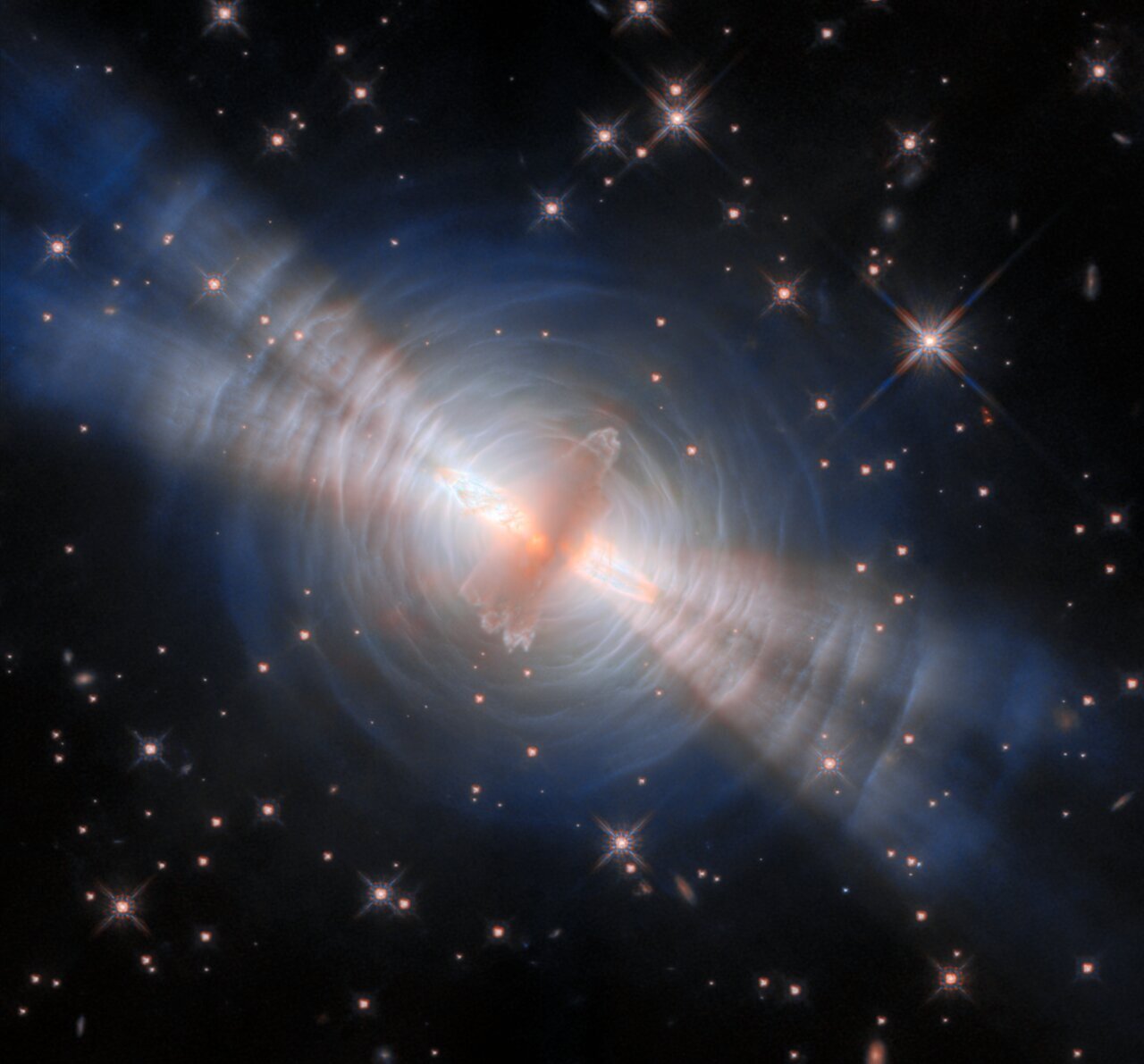

The Hubble Space Telescope has captured a detailed new image of the Egg Nebula, revealing the complex structure of a star in its final stages of life. The observation provides a direct look at a brief, critical phase of stellar evolution that lasts only a few centuries. This process offers a preview of the eventual fate of our own Sun, making the findings relevant for understanding the lifecycle of similar stars.

The Egg Nebula is located approximately 1,000 light-years from Earth within the constellation Cygnus. It is classified as a pre-planetary nebula, a transitional stage where a dying star sheds its outer layers before becoming a planetary nebula. The new data allows astronomers to peer through the surrounding dust to study the mechanisms of this mass loss.
Understanding a Star’s Final Act
The image highlights concentric rings of dust and gas ejected by the central star over hundreds of years. These rings, illuminated by light from the hidden star, act as a historical record of its mass loss. The structure is created as the star pulses and expels material at regular intervals, a process that is not yet fully understood.
This phase is astronomically brief, estimated to last only a few hundred years. It precedes the formation of a full planetary nebula, where the exposed hot core of the star ionizes the ejected gas, causing it to glow brightly for a longer period. The Egg Nebula is currently in the short window where the central star is not yet hot enough to ionize the surrounding shell.
Implications for Solar Science
The processes observed in the Egg Nebula are directly applicable to the future of our Solar System. In roughly five billion years, the Sun is expected to exhaust the hydrogen fuel in its core and expand into a red giant. It will then undergo a similar period of mass loss, shedding its outer layers into space.
Studying objects like the Egg Nebula helps scientists model the specific behavior of Sun-like stars during this unstable and rapid phase. The data contributes to more accurate predictions about the Sun’s evolution and its impact on the planets, including Earth.
The Hubble observation relied on the telescope’s advanced imaging capabilities to filter specific wavelengths of light. This technique helps isolate the structure of the dust rings from the glare of the central starlight, providing a clearer view of the nebula’s anatomy.
Future Observations and Research
Astronomers plan to continue monitoring the Egg Nebula with Hubble and other observatories, including the James Webb Space Telescope. The next phase of research will focus on measuring changes in the dust shell’s expansion and composition over time. This longitudinal data is crucial for timing the star’s transition into a full planetary nebula.
Further analysis aims to determine the precise chemical makeup of the ejected material. This information will clarify how such stars enrich the interstellar medium with heavy elements, which are essential building blocks for future stars and planetary systems. The ongoing study of pre-planetary nebulae remains a key priority for understanding stellar death cycles across the galaxy.
Source: Mashable