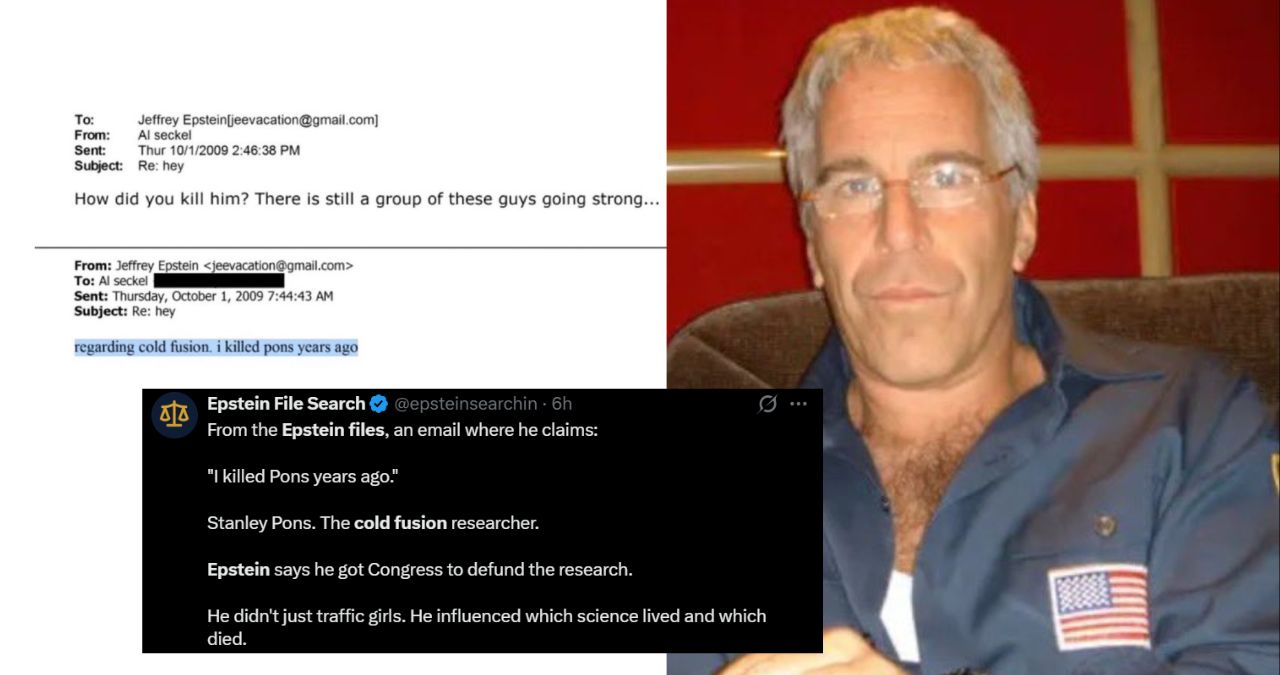

Newly unsealed court documents related to the late financier Jeffrey Epstein contain an email in which he appears to claim responsibility for disrupting the research of scientist Stanley Pons, a key figure in the controversial field of cold fusion. The claim, which has not been independently verified, has sparked discussions about scientific suppression and the influence of powerful networks on technological innovation.
Content of the Unsealed Email
The email, released as part of a tranche of documents from a lawsuit involving Epstein associate Ghislaine Maxwell, was reportedly sent by Epstein. In it, he states he was responsible for derailing Pons’s work. The message does not provide specific details on the methods used. The unsealing is part of ongoing legal proceedings following Epstein’s 2019 death while awaiting trial on sex trafficking charges.
Background on Cold Fusion and Stanley Pons
In 1989, electrochemists Stanley Pons and Martin Fleischmann announced at a press conference that they had achieved nuclear fusion at room temperature in a simple laboratory setup, a process dubbed “cold fusion.” Their claim, suggesting a potential source of nearly limitless clean energy from water, caused a global sensation. However, subsequent attempts by major laboratories worldwide failed to reliably replicate their results. The broader scientific community largely dismissed the work, and the field became synonymous with fringe science, though a small community of researchers continues to investigate it under the name Low-Energy Nuclear Reactions (LENR).
Reactions from the Scientific Community
Reaction to the email’s content from mainstream scientists has been skeptical. Many experts emphasize that cold fusion was discredited through the standard scientific process of peer review and replication failure, not through external interference. They note that extraordinary claims require extraordinary evidence, which the original Pons and Fleischmann experiment did not provide to the satisfaction of the physics community. There is no widely accepted theoretical framework that explains how cold fusion could work at room temperature.
Questions of Influence and Speculation
The emergence of this claim within the Epstein files has nevertheless fueled existing conspiracy theories. These theories often suggest that revolutionary energy technologies are suppressed by established industries or governments to maintain the status quo. The connection to Epstein, a convicted sex offender with deep ties to global elites, academics, and politicians, adds a layer of intrigue about potential shadow networks capable of influencing scientific direction. The documents do not provide evidence to substantiate Epstein’s claim or clarify his motives.
Legal and Investigative Context
The email was unsealed by a federal judge in New York. The documents are publicly accessible, part of a case that has already revealed numerous names of Epstein’s associates. Legal experts caution that the contents of the documents are allegations and claims, not established facts, and have not been tested in a court of law. The primary focus of the lawsuit and document releases remains on allegations of sexual abuse and trafficking, not scientific matters.
Based on the current legal schedule, further documents from related cases may continue to be released throughout the year. It is unclear if any official scientific body or government agency will investigate the specific claim about Stanley Pons, given its source and the settled consensus within mainstream physics. The story is likely to remain a point of discussion in circles interested in alternative energy and conspiracy theories, rather than triggering a formal reevaluation of cold fusion science.
Source: Various court documents