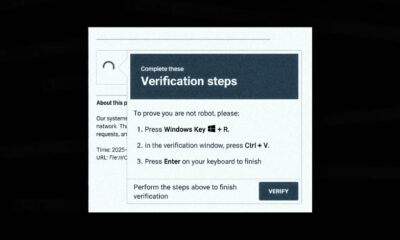
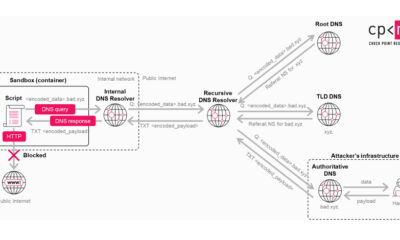
Microsoft has disclosed details of a new version of a social engineering attack, dubbed ClickFix, that tricks users into running commands to retrieve malware via the Domain Name System. The technique, observed in recent campaigns, leverages the legitimate Windows “nslookup” tool to fetch malicious payloads directly from DNS servers, bypassing traditional file-based detection.
Attack Methodology and Technical Details
The attack begins with a social engineering lure, often a phishing email or a compromised website. The target is instructed to copy and paste a specific command into the Windows Command Prompt. This command uses the “nslookup” utility, a standard network administration tool for querying DNS servers to obtain domain name or IP address mappings.
In this malicious adaptation, the command is crafted to query a domain controlled by the attackers. The DNS server’s response does not contain a simple IP address; instead, it carries encoded instructions or a script within a DNS text record. This encoded data is the next-stage malware payload.
Once the “nslookup” command executes and receives the response, a subsequent command, also provided by the attacker, decodes the information from the DNS record. This process ultimately writes a malicious script or executable file directly onto the victim’s computer, enabling further compromise.
Significance and Evasion Tactics
This method is significant because it uses a trusted, built-in system tool for malicious purposes. Security software often whitelists common administrative tools like “nslookup,” as they are essential for normal operations. By using this tool for staging, attackers can avoid triggering security alerts that would normally be associated with downloading a file from the internet.
Furthermore, the attack utilizes the DNS protocol itself for data exfiltration and payload delivery. This is a form of “DNS tunneling.” Since DNS traffic is fundamental to internet connectivity and is rarely blocked, malicious communications can blend in with legitimate network noise, making detection more challenging for network defenders.
Microsoft’s Analysis and Recommendations
Microsoft’s security researchers, who published the findings, categorize this as an evolution of the “ClickFix” technique. Earlier versions relied on tricking users into running malicious JavaScript or PowerShell commands. The shift to “nslookup” represents a tactical change to improve the attack’s stealth.
The company advises organizations to implement multiple layers of security. Key recommendations include applying the principle of least privilege to user accounts to limit the impact of executed commands, deploying advanced endpoint detection and response solutions that can monitor for suspicious process chains, and closely monitoring DNS traffic for anomalous patterns, such as unusually long text records or queries to newly registered, suspicious domains.
User education remains a critical defense. Individuals should be cautioned against executing commands prompted by unsolicited emails, messages, or websites, regardless of how innocuous the instructions may seem.
Broader Industry Context
The disclosure follows a trend of attackers increasingly abusing legitimate tools and protocols, a technique known as “Living-off-the-Land.” This approach allows threat actors to hide in plain sight within a system’s normal operations. The abuse of DNS for covert communication and data transfer is a well-documented, persistent threat that requires specific defensive strategies beyond standard web filtering.
Next Steps and Expected Developments
Microsoft is expected to continue monitoring for campaigns utilizing this “nslookup” method and may release additional detection rules through its Defender security platform. Other security vendors are likely to analyze the technique and update their own threat intelligence feeds and detection capabilities accordingly. Organizations should anticipate that attackers will continue to refine this method and develop counter-detection measures, making ongoing vigilance and layered security postures essential.
Source: Microsoft Security Threat Intelligence