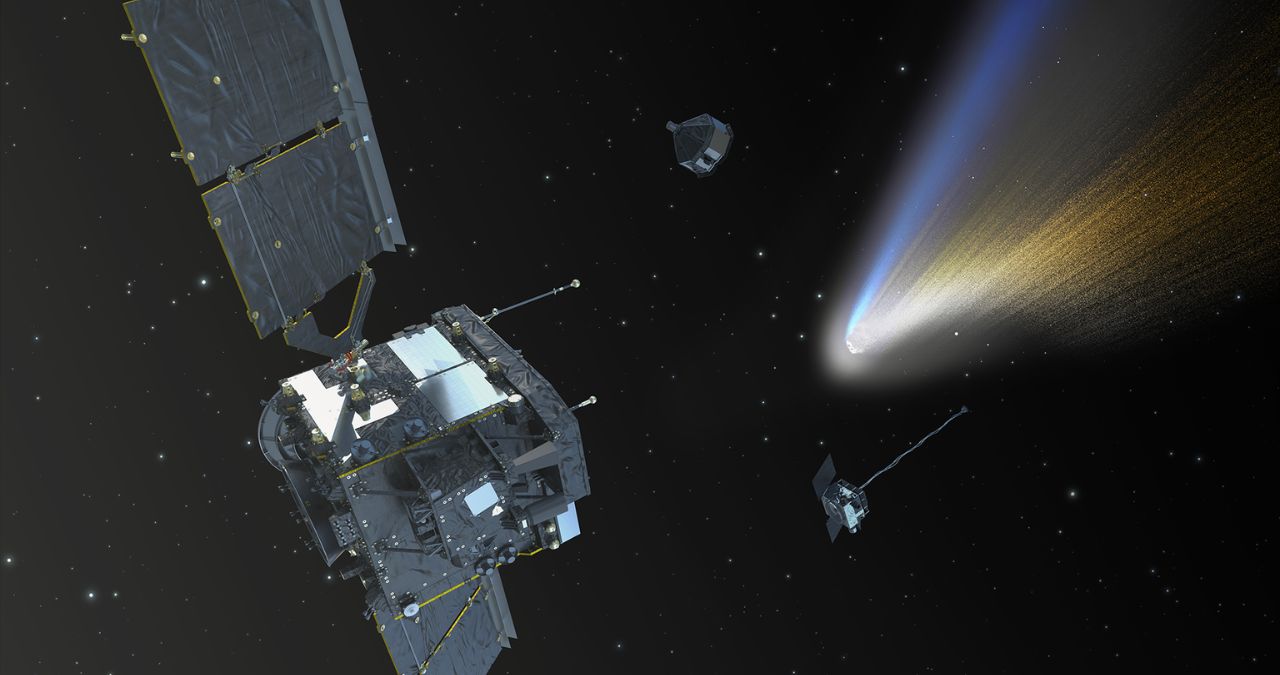

A consortium of international scientists has announced a detailed, multi-decade mission plan to intercept and study the interstellar comet 3I/Borisov, also known as Comet ATLAS. The plan, which involves a complex series of spacecraft launches and gravity assists, aims to deploy a probe to the object before it leaves the inner solar system. Researchers emphasize that the mission must begin within the next few years to have any chance of success.
The announcement was made during a press briefing at the European Space Agency’s operations center. The proposed mission is a response to the unique scientific opportunity presented by the comet’s passage. As only the second confirmed interstellar object ever observed, 3I/Borisov offers an unprecedented chance to study material unaltered by our Sun’s heat and radiation.
A Race Against Time
The core challenge of the mission is the comet’s high velocity and trajectory. 3I/Borisov is traveling at approximately 110,000 miles per hour and is on a hyperbolic path, meaning it will not return. Current estimates suggest a launch window for an intercept mission would need to occur between 2027 and 2030. Any delay beyond that would make a rendezvous technologically impossible with near-future propulsion systems.
The proposed flight plan is extraordinarily complex. It would require multiple gravity-assist maneuvers around Earth and Jupiter to slingshot a spacecraft onto a path that matches the comet’s speed and course. Even with this optimized trajectory, the journey to the comet would take several decades, with a potential encounter date in the 2050s.
Scientific Objectives and Challenges
The primary goal of the mission is to conduct a close flyby, capturing high-resolution images and directly analyzing the comet’s composition. Scientists hope to determine the object’s structure, the chemistry of its ices and dust, and whether it contains prebiotic molecules. This data could provide clues about the formation of planetary systems around other stars.
Mission planners acknowledge significant hurdles. The long duration presents risks to spacecraft electronics and power systems. Furthermore, securing the substantial international funding and cooperation required for a project spanning 50 years is a major political and logistical obstacle. Several space agencies, including NASA and ESA, are in preliminary discussions regarding the feasibility of a collaborative effort.
Background on an Interstellar Visitor
Comet 3I/Borisov was discovered in August 2019 by amateur astronomer Gennadiy Borisov. It was identified as interstellar due to its extreme orbital eccentricity, confirming it originated from outside our solar system. The first known interstellar object, 1I/’Oumuamua, passed through in 2017 but was detected too late for any mission planning.
Observations from telescopes like Hubble have shown that 3I/Borisov has a familiar cometary structure, with a nucleus and a distinct tail of gas and dust. This makes it a more predictable and perhaps a richer target for study compared to the enigmatic ‘Oumuamua.
Next Steps and Future Prospects
The scientific team behind the proposal will now begin a formal feasibility study to refine the mission architecture and cost estimates. A key milestone will be the presentation of their findings to the decadal survey committees of major space agencies, which set scientific funding priorities. The decision to proceed with development must be made within the next two to three years to meet the critical launch window. If approved, the first spacecraft components could begin construction before the end of this decade, initiating a half-century quest to touch a piece of another star system.
Source: Adapted from scientific briefing materials.