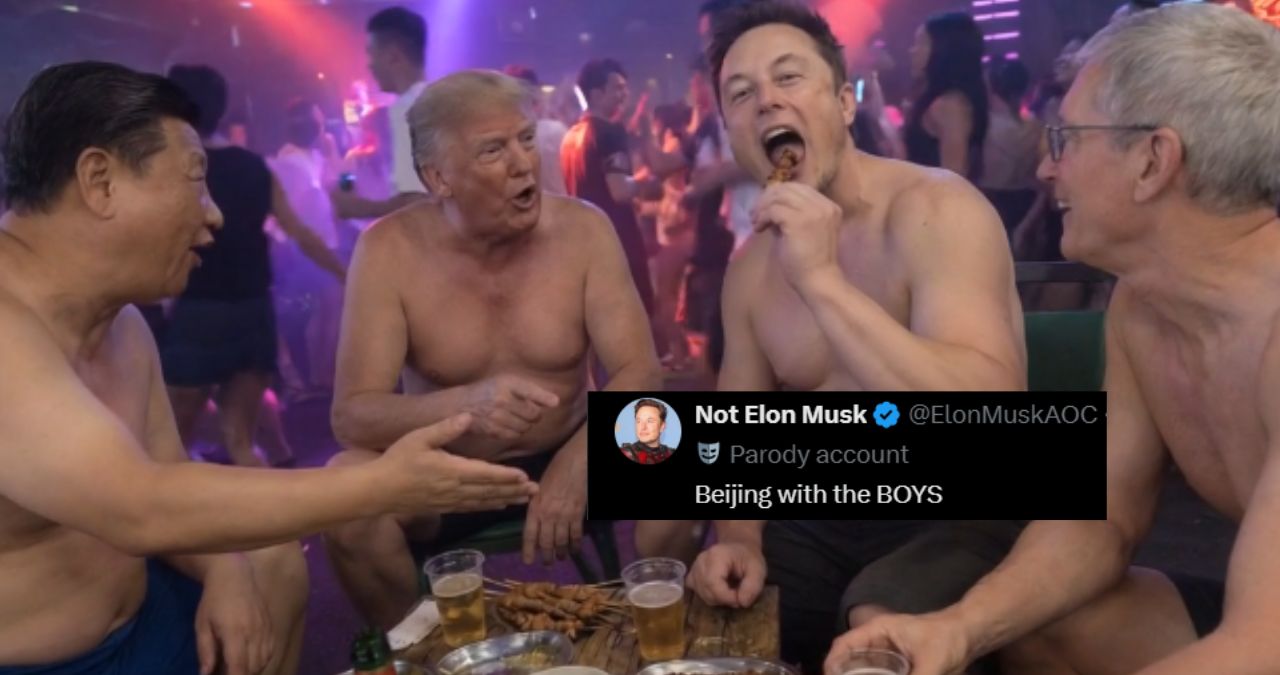

A wave of AI-generated memes circulating on Chinese social media has depicted former U.S. President Donald Trump alongside Chinese President Xi Jinping, Tesla CEO Elon Musk, and Apple CEO Tim Cook in a fictional Beijing street party. The content has quickly gone viral, highlighting the growing sophistication and reach of AI image and video generation tools in China.
The video, which began circulating on platforms such as Weibo and Douyin in mid-May 2025, uses deepfake and generative AI techniques to superimpose the faces of global political and business figures onto animated characters. The setting is a stylized street scene in Beijing, featuring traditional Chinese decorations and festive music.
Content and Reactions
In the video, Trump is shown dancing and interacting with the other figures, including Xi Jinping, Elon Musk, and Tim Cook. The memes are generally described as satirical and humorous, without overtly political messaging. However, their rapid spread has sparked discussions about the use of AI for creating viral content involving public figures.
Chinese social media users have engaged broadly with the material, sharing and remixing the clips. The video has accumulated millions of views across multiple platforms. Reactions range from amusement to concern about the ease with which realistic but fabricated content can be produced and disseminated.
Xi Jinping, Elon Musk, and Tim Cook are depicted without context, simply as characters in the AI-generated party scene. The inclusion of these specific individuals appears to be a creative choice rather than a commentary on any real world alliances or events.
Implications of AI Meme Culture
The virality of the Beijing street party video underscores the mainstreaming of advanced AI tools for content creation. In China, access to generative AI models has expanded significantly in recent years, with state approved companies like Baidu and Alibaba offering platforms that allow users to create images and videos from text prompts.
This phenomenon raises questions about the public perception of AI generated media. While the video is widely considered a form of digital art or parody, it demonstrates the potential for such technology to be used in ways that blur the line between reality and fabrication.
Experts note that the cultural context of memes, which often rely on shared understanding and humor, can mitigate some concerns. However, the same technology could be applied to create misleading or harmful content in less clear cut scenarios.
Neither Trump, Xi Jinping, Musk, nor Cook have publicly commented on the AI video. The White House and the Chinese Foreign Ministry have not issued statements regarding the memes. Apple and Tesla declined to comment when approached by media outlets.
Technical and Regulatory Context
China has implemented regulations regarding deepfakes and AI generated content. The Cyberspace Administration of China (CAC) requires that AI generated media be clearly labeled as such to prevent misinformation. The viral video initially circulated without disclaimers, but many reposts later added notes identifying it as AI generated.
The CAC has not publicly addressed this specific video. However, its policies indicate a focus on transparency rather than outright bans on creative AI uses.
Global regulators are also watching these developments. The European Union’s AI Act and similar frameworks in other regions seek to impose transparency obligations for synthetic media. The viral Beijing street party video is likely to be cited as an example in ongoing policy debates.
As AI tools become more accessible, the line between benign parody and potential misinformation will continue to be tested. The speed at which such content spreads across social networks presents challenges for moderation and verification.
Looking ahead, the trend of AI generated celebrity memes is expected to persist. Platforms will likely face increased pressure to implement detection and labeling mechanisms. The incident serves as a case study for how public figures and governments may interact with this rapidly evolving technology. No official timelines for regulatory updates or platform policy changes have been announced in direct response to this video.
Source: Mashable