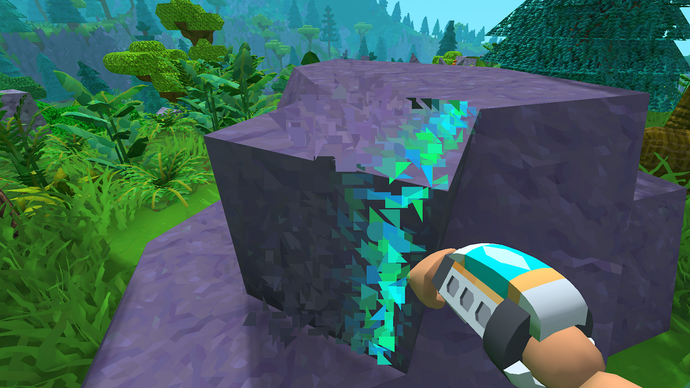

The Dundee-based video game developer <a href="https://delimiter.online/blog/4j-studios-Reforj/” title=”4J Studios”>4J Studios has publicly detailed a new graphics technology designed to reduce the memory footprint of video game textures by approximately 98 percent. The company, known for its work on the upcoming sandbox title Reforj, has filed a patent application for the system, which it has branded as Rixels. This announcement marks a significant step in addressing one of the persistent technical limitations in modern game development: the high memory cost associated with high-resolution imagery.
The new approach redefines the fundamental structure of how textures are stored and processed. Traditionally, textures rely on individual pixels, each containing complete color and detail information. The proposed Rixel system modifies this standard by using a more efficient method of data storage, allowing for the same visual fidelity without the heavy spatial requirements. According to the studio, this reduction in memory usage could free up significant resources, potentially enabling larger, more detailed, and more complex environments to run on current hardware.
Technical Implications for Game Development
The core advantage of this technology lies in its potential to streamline asset loading and virtual memory management. In standard practice, streaming high-detail textures into a scene requires large amounts of random-access memory (RAM) and graphics memory (VRAM), which can strain performance, particularly on consoles and handheld devices with fixed hardware specifications. By reducing the necessary bandwidth and storage space, Rixels could allow developers to increase the density of visual detail in a scene without incurring the usual performance penalties.
This innovation could specifically benefit procedurally generated worlds, where the system must generate and display vast terrain features in real time. For Reforj, the studio’s current project, the ability to manipulate the world with voxel-based building mechanics relies heavily on efficient use of system memory. The introduction of Rixels may allow for a smoother interaction between the player and the environment, with less load on the processing unit and faster response times for texture streaming.
Context Within the Reforj Project
Reforj is positioned as a building and exploration title that emphasizes the ability to alter the terrain itself. The technical demands of such a game are considerable, as players may modify the environment in ways that require immediate visual updates. The implementation of Rixels is expected to assist in these scenarios, providing a more consistent frame rate and reducing instances of texture pop-in, where objects appear blurry before resolution catches up.
The move to patent the technology suggests that 4J Studios intends to secure its intellectual property in this area, potentially licensing the system to other developers in the future. The company has not yet specified a public timeline for when the patent will be granted or whether the technology will be available for third-party use outside of its own titles.
Official Statements and Current Status
Representatives from 4J Studios have confirmed that the technology is currently in active use within the development environment for Reforj. The studio has shared visual examples of the system in action, highlighting the clarity of the textures in screenshots taken from the game engine. Specific technical documentation regarding the mechanics of Rixels has not been released to the public, but the assertion of a 98% reduction in memory requirements positions the patent as a potentially disruptive element in the field of real-time 3D rendering.
Market Position and Future Outlook
The announcement places 4J Studios in direct competition with other developers and hardware manufacturers who are seeking solutions to the growing size of game installations. The industry has seen a trend toward larger storage requirements, with some modern titles exceeding 100 gigabytes. Innovations that compress or reimagine standard data formats without sacrificing visual quality are becoming increasingly valuable.
The studio has stated that development on Reforj will continue while the patent application is processed. The next steps for the company involve further stress-testing the technology on various hardware configurations to ensure stability and compatibility. No release date has been announced for the game, but the public reveal of this underlying technology suggests that the team is preparing for a potential production milestone in the near future.
Source: GamesIndustry.biz