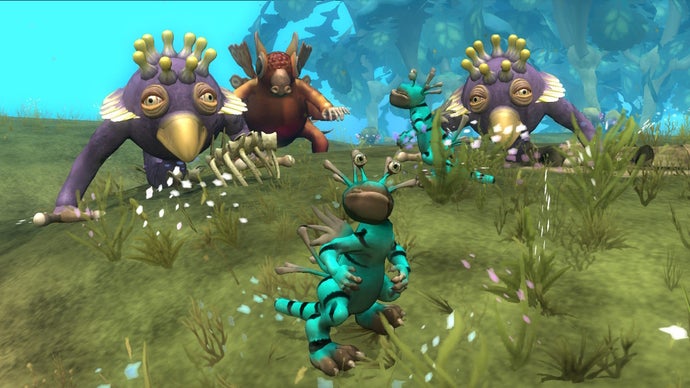

A retrospective on Maxis’ creature simulation game Spore has detailed the significant operational challenges that defined its nine year development cycle, shedding light on the internal struggles behind the ambitious title.
The developers of Spore, including lead designer Will Wright, discussed the game’s lengthy creation process in a recent interview. Wright noted the unusual freedom granted during development, stating, “I was given that opportunity to go crazy and do something kind of insane.” This comment reflects the scope of the project, which aimed to simulate evolution from a single cell organism to an interstellar civilization.
Development timeline and internal hurdles
Spore was first announced in 2005 but had been in production since 2000. The project faced repeated delays and shifts in direction. Developers cited the difficulty of integrating multiple distinct gameplay phases into a single cohesive experience. The game required a unified engine capable of handling everything from microscopic physics to space exploration.
Maxis, the studio behind the popular Sims franchise, struggled to maintain a consistent vision. The game’s scope led to frequent scope changes and technical challenges. Developers described the process as a “war” within the company, with different teams vying for control over the final product. One developer said the team “wasted” significant time on features that were later cut.
Impact of studio size and corporate oversight
The size of the Maxis team also presented problems. The studio employed hundreds of people, making communication and coordination difficult. Electronic Arts, the publisher, provided substantial resources but also imposed deadlines that conflicted with the game’s experimental nature. The constant pressure to meet commercial expectations contributed to development delays.
Despite these issues, the game eventually launched in 2008. It was a commercial success, selling over two million copies in its first month. However, critical reception was mixed. Reviewers praised the creature creator but criticized the simplified gameplay of later stages, such as the space and tribal phases.
Legacy and lessons learned
The Spore development process is now studied as a cautionary tale in game design. It highlights the risks of overly ambitious scope combined with a lack of clear direction. The game failed to deliver on many of its original promises, such as a fully emergent physics system and a seamless transition between life stages.
Will Wright later left Maxis to found a new studio. Electronic Arts shuttered Maxis in 2015, though a new studio under the same name, Maxis Redwood Shores, continues to work on The Sims franchise. The Spore project remains one of the most documented examples of how operational challenges can shape a game’s final form, for better or worse.
Source: GamesIndustry.biz