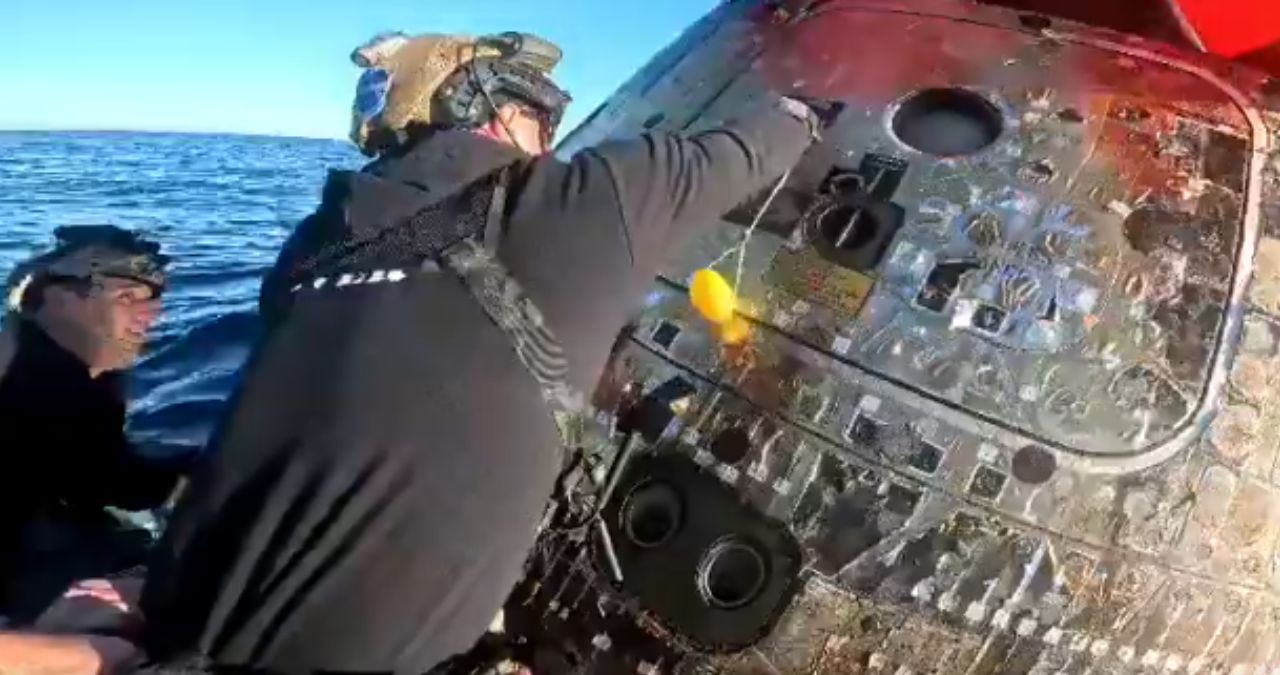

The four NASA astronauts of the Artemis II mission have been successfully recovered from the Pacific Ocean, marking the first human contact following a historic lunar flyby. The crew module, named Orion, splashed down off the coast of California as planned, concluding a mission that tested critical systems for future Moon landings.
Recovery teams from NASA and the U.S. Navy executed a complex operation to secure the spacecraft and assist the astronauts. The process involved multiple vessels and divers who worked to ensure the capsule was stable before opening the hatch. The moment the hatch was opened represented the official end of the crew’s journey in space.
Mission Objectives and Significance
The Artemis II mission served as the first crewed flight test of NASA’s Orion spacecraft and Space Launch System (SLS) rocket. Its primary objective was to validate life support, communication, and navigation systems with astronauts aboard during a journey around the Moon. The successful splashdown and recovery are considered major milestones.
This mission paves the way for Artemis III, which aims to land astronauts on the lunar surface. The data collected from Artemis II regarding crew health and spacecraft performance during re-entry and recovery is vital for planning longer-duration missions.
Recovery and Crew Health
Following splashdown, the astronauts underwent initial medical checks inside the recovery vessel. NASA officials reported that all crew members were in good health and high spirits. They were transported to a nearby medical facility for standard post-mission evaluations, a protocol for all astronauts returning from space.
The recovery of the Orion capsule itself is also a key part of the operation. Engineers will inspect the spacecraft to assess its condition after enduring the intense heat of atmospheric re-entry. This analysis will inform final designs for future missions.
Path Forward for Artemis Program
With the conclusion of Artemis II, NASA and its international partners will shift focus to the development of hardware for Artemis III. This includes the lunar lander, next-generation spacesuits, and the Gateway lunar outpost. Each component must be rigorously tested before a landing attempt can proceed.
Based on current official timelines, the Artemis III mission, targeting a human landing near the lunar South Pole, is projected for no earlier than 2026. The schedule remains dependent on the outcomes of ongoing tests and the readiness of all necessary systems.
Source: NASA