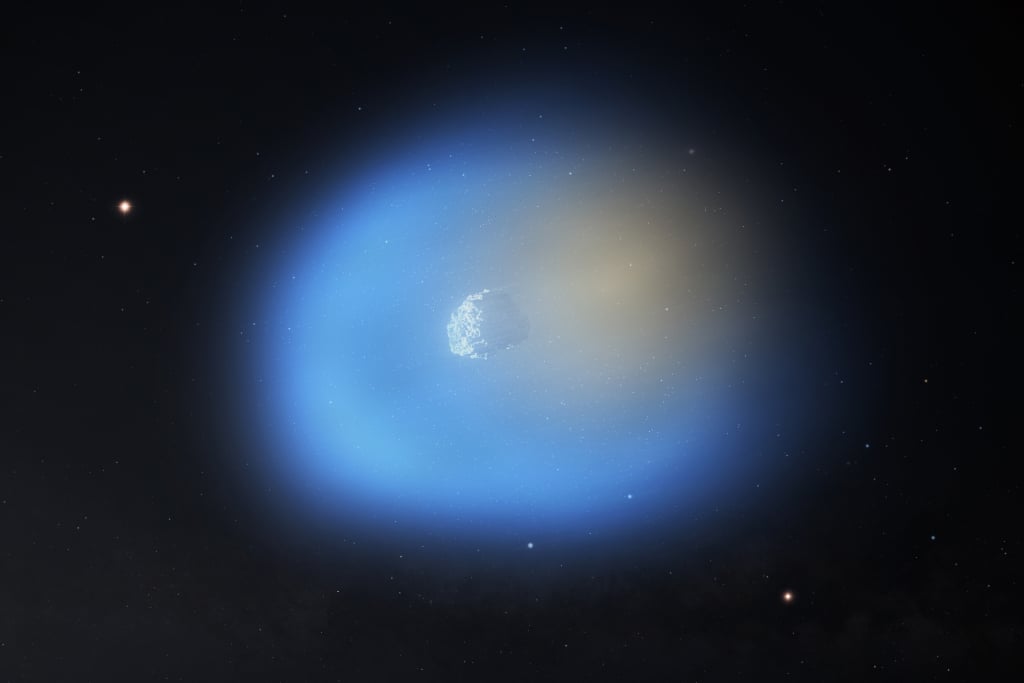

Astronomers have detected an unusual chemical signature in gases streaming from an interstellar comet, challenging existing models of planetary formation in distant star systems. The discovery was made as scientists analyzed data from the interstellar object 3I/ATLAS during its passage through our solar system.
The research team identified two specific gases, methanol and hydrogen cyanide, being released from the comet’s icy surface. The ratio of these chemicals was markedly different from that typically observed in comets originating within our own solar system. This finding provides a direct sample of material from another planetary system, offering a rare opportunity for comparative analysis.
Scientific Methodology and Observations
Researchers used spectroscopic instruments on ground-based telescopes to analyze the light passing through the comet’s coma, the cloud of gas and dust surrounding its nucleus. This technique allows scientists to identify specific chemical compounds by their unique spectral fingerprints. The observations were conducted over several weeks as the comet traveled through the inner solar system.
The detection of hydrogen cyanide was expected, as it is common in solar system comets. However, the amount of methanol measured relative to hydrogen cyanide was significantly lower than in any previously studied comet from our cosmic neighborhood. This quantitative difference forms the core of the scientific puzzle.
Implications for planetary science
The chemical composition of comets serves as a frozen record of the conditions in the protoplanetary disk from which their parent system formed. The distinct chemical recipe found in 3I/ATLAS suggests that the environment around its home star differed substantially from the primordial cloud that gave birth to our sun and planets.
This variation could result from several factors, including different temperatures in the comet’s formation region, varying radiation levels from its host star, or distinct chemical abundances in its native molecular cloud. Each possibility carries implications for understanding the diversity of planetary systems across the galaxy.
Context of Interstellar Visitors
3I/ATLAS is only the third interstellar object confirmed to have passed through our solar system, following 1I/’Oumuamua in 2017 and 2I/Borisov in 2019. Unlike its predecessors, this comet provided a clearer opportunity for detailed chemical analysis due to its higher level of activity as it approached the sun.
The study of such visitors offers a form of remote sampling without the need for interstellar spacecraft missions. Each object functions as a natural probe, delivering material from its system of origin directly to our astronomical observatories.
Future observations will focus on continuing to monitor 3I/ATLAS as it departs the solar system, though it is becoming increasingly faint. Astronomers worldwide are preparing for the next detection of an interstellar object, with improved survey telescopes expected to find such visitors more frequently in coming years.
Research teams plan to apply the analytical techniques developed during this study to future interstellar objects. The growing sample size will help determine whether 3I/ATLAS represents a common or exceptional type of interstellar comet, gradually building a taxonomy of chemistry from other stars.