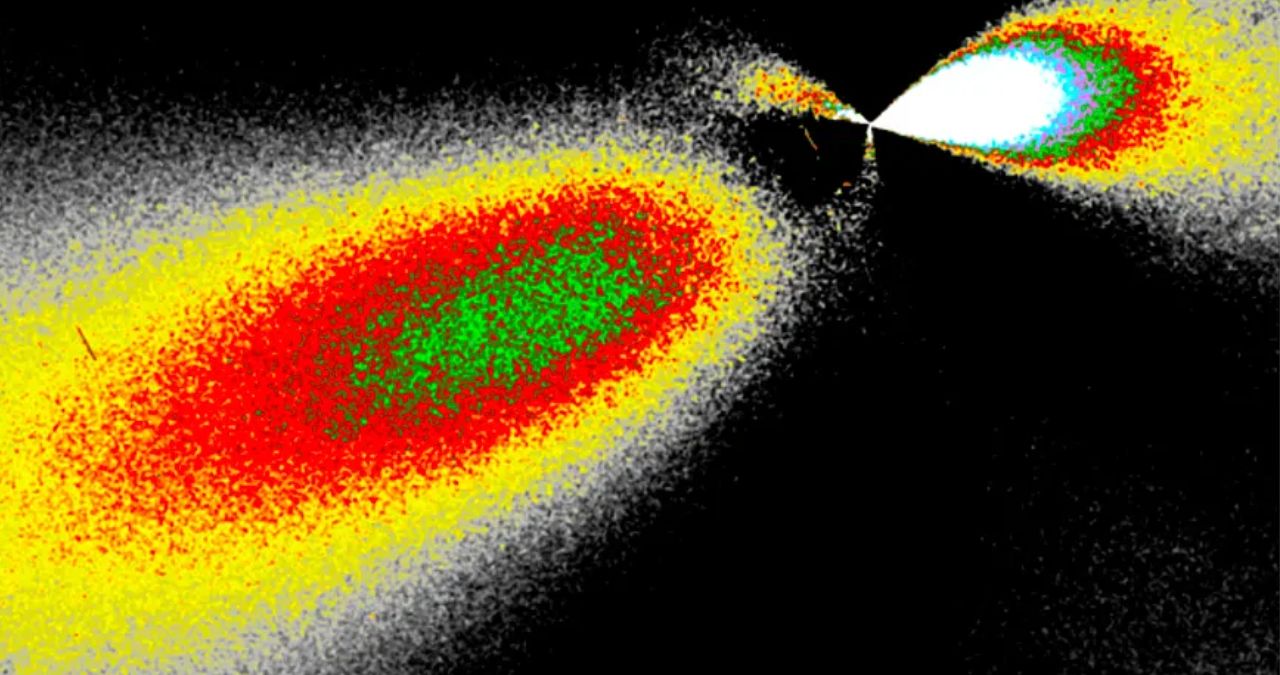

Astronomers have detected a strange, rhythmic pulse emanating from a system of three symmetric jets associated with the object 3I/ATLAS, with the entire structure wobbling on a precise seven-hour cycle. The discovery, based on observational data, presents a new mystery for scientists studying interstellar objects and astrophysical jets. The finding is significant as it challenges existing models of jet formation and behavior, potentially pointing to an unknown physical mechanism at work within this system.
Observational Details and Anomalous Behavior
The three jets were observed emanating from a central source in a remarkably symmetrical configuration. This symmetry alone is noteworthy in astrophysical phenomena, where chaotic forces often dominate. However, the defining characteristic of this discovery is the consistent, clockwork variation in the jets’ orientation and intensity, repeating every seven hours.
This rhythmic “wobble” or pulse was not predicted by standard theories. Typically, such periodic behavior in astrophysical jets is linked to the rotation of the central object, like a star or black hole, or to orbital mechanics in a binary system. The precise seven-hour period, coupled with the triple-jet structure, does not neatly fit these established explanations.
Scientific Significance and Current Theories
The primary importance of this observation lies in its potential to reveal new physics. The regularity suggests a highly stable underlying process, yet one that current astrophysical models struggle to account for. Researchers are now tasked with determining the source of this periodicity.
Initial hypotheses being considered by the scientific community include the possibility of a precessing accretion disk, where swirling matter falling onto a central body wobbles like a spinning top. Another theory involves a central object with an extremely strong and complex magnetic field that channels material into jets in a rotating pattern. The interaction between three stable jets adds a significant layer of complexity to these models.
Background on 3I/ATLAS and Astrophysical Jets
3I/ATLAS is an interstellar object, originally identified as a comet, that entered our solar system. The designation “3I” marks it as the third interstellar object ever confirmed. Astrophysical jets are powerful, collimated streams of plasma ejected from the vicinity of celestial objects like young stars, neutron stars, or black holes. They are key to understanding energetic processes in the universe, but a triple-jet system with a coherent pulse is exceptionally rare.
The observation underscores the value of continued monitoring of interstellar visitors, as they can exhibit phenomena not commonly seen within our own solar system, offering unique natural laboratories.
Next Steps in the Investigation
The international teams involved in this discovery are now coordinating further observations across multiple wavelengths, including radio, infrared, and optical telescopes. The immediate goal is to gather more precise data on the jet composition, velocity, and magnetic fields to constrain theoretical models.
Peer-reviewed papers detailing the full analysis are in preparation and expected to be submitted to major astronomical journals in the coming months. These publications will formally present the data and invite global scrutiny and collaboration from the astrophysics community to solve this new seven-hour mystery.
Source: Based on observational data reports