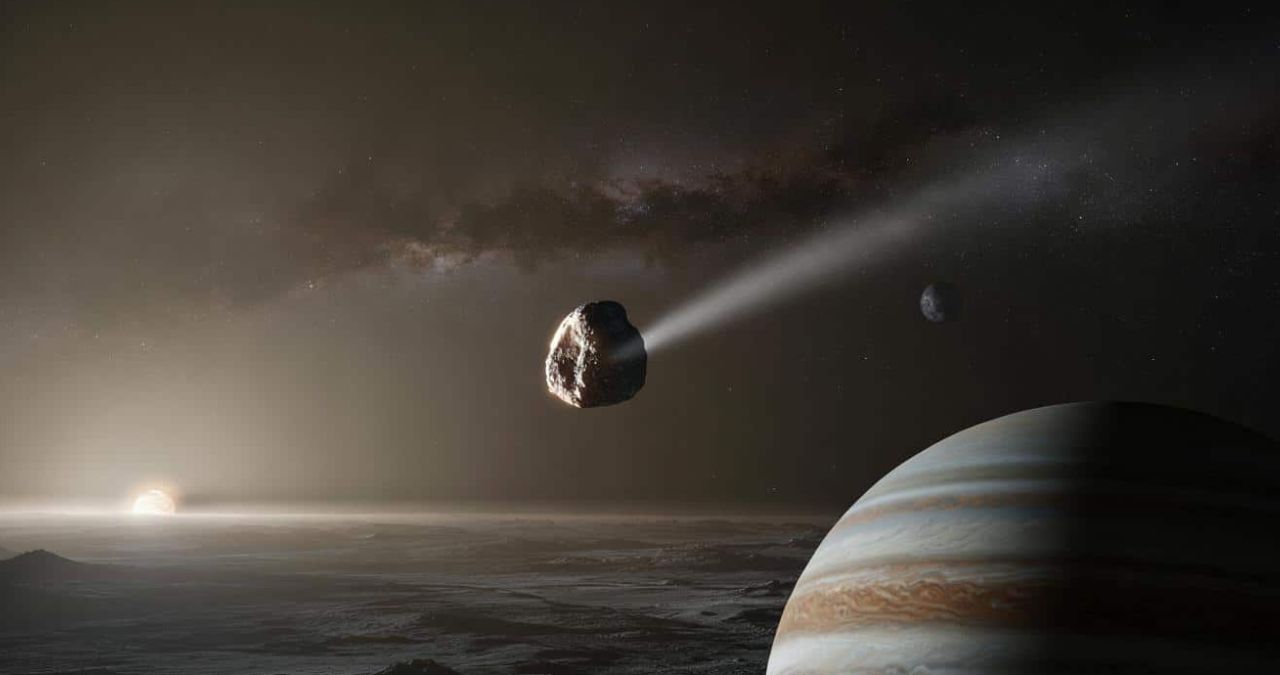

Astronomers and filmmakers have released a continuous 28-hour silent film documenting the journey of the interstellar comet 2I/Borisov. The project, titled “3I/ATLAS,” was created using data from the Asteroid Terrestrial-impact Last Alert System (ATLAS) telescopes in Hawaii and South Africa, capturing the comet’s passage through our solar system in late 2019 and early 2020.
Project Origins and Scientific Basis
The film is a data visualization compiled from over 2,500 individual observations made by the ATLAS survey. Each frame represents a 30-minute exposure, stitched together to create a seamless, real-time view of the comet’s motion against the background stars. The ATLAS system, operated by the University of Hawaii Institute for Astronomy, is primarily designed to detect potentially hazardous asteroids but proved adept at tracking this rare interstellar visitor.
Comet 2I/Borisov was discovered by amateur astronomer Gennadiy Borisov in August 2019. It was only the second confirmed object to visit our solar system from another star system, following the discovery of ‘Oumuamua in 2017. Unlike its rocky predecessor, 2I/Borisov displayed a classic cometary composition with a visible coma and tail, providing scientists with a unique opportunity to study pristine material from another planetary system.
Content and Presentation of the Film
The resulting film shows the comet as a bright, moving object with a distinct tail, traversing the constellation Crater. The “3I” in the title stands for the third interstellar object discovered, following 1I/’Oumuamua and 2I/Borisov itself. The project team describes the visual style as reminiscent of a “found-footage” genre for space, presenting raw astronomical data in a cinematic timeline.
The film is presented without sound or narration, emphasizing the direct visual data. The creators note that the silence is intentional, allowing viewers to focus on the sheer duration and distance implied by the comet’s steady progression. The footage covers the period from December 2019 to January 2020, when the comet was near its brightest and closest approach to the Sun.
Scientific Value and Public Outreach
While the film is an artistic visualization, it is rooted in precise scientific data. The sequence allows both researchers and the public to observe the comet’s consistent activity and stable rotation over an extended period. Scientists analyzed this ATLAS data to determine the comet’s size, composition, and the properties of its dust tail, publishing their findings in several academic journals.
Projects like “3I/ATLAS” bridge the gap between scientific research and public engagement. By transforming telemetry and images into a continuous narrative, they make complex astronomical events more accessible. The film serves as a permanent visual record of a historic astronomical event, preserving the comet’s visit in a unique format.
Future Implications and Research
The completion of the “3I/ATLAS” film highlights the growing capability of survey telescopes to track and record non-sidereal objects in extreme detail. The techniques developed for this project are expected to be applied to future interstellar interlopers. With next-generation observatories like the Vera C. Rubin Observatory coming online, astronomers anticipate detecting many more such objects each year.
Researchers plan to use similar time-lapse methodologies to study other transient phenomena, including near-Earth asteroids and distant comets. The team behind the film has indicated that the raw data remains available for further scientific analysis, and the visualization framework may be adapted for educational purposes in planetariums and science centers. The ongoing analysis of 2I/Borisov’s chemical signatures continues, with scientists worldwide working to decode its origins and what it reveals about planet formation in other star systems.
Source: Mashable